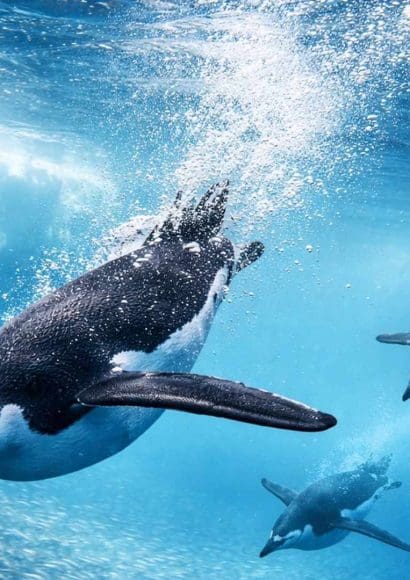
Have you ever wondered how penguins live in the coldest place on Earth? The behavior of penguins in Antarctica. is a story of teamwork, courage, and clever survival. These birds do not fly in the sky. Instead, they “fly” in the water. They walk with a funny waddle. They slide on their bellies. And most importantly, they survive in a land of ice and wind.
In this article, you will discover how penguins eat, protect their babies, stay warm, and talk to each other. Moreover, you will see how their daily life teaches us powerful lessons about unity and resilience. So, let’s dive into the icy world of Antarctica.
Contents
Life in the Frozen Continent🐟
Before we explore penguin behavior, we need to understand their home. Antarctica is the coldest, driest, and windiest continent on Earth. Temperatures can drop below -50°C (-58°F). Furthermore, strong winds blow almost every day.
However, despite these harsh conditions, penguins thrive there. Why? Because they have adapted in amazing ways.
One of the most famous penguin species is the Emperor penguin. These birds live deep in Antarctica and face the coldest winters. Another well-known species is the Adélie penguin, which prefers coastal areas.
Therefore, even in extreme cold, penguins have built a life full of activity and purpose.
Social Behavior: Together Is Better🐟
Huddling to Survive
First of all, penguins are very social animals. They live in large groups called colonies. Sometimes, these colonies include thousands of birds.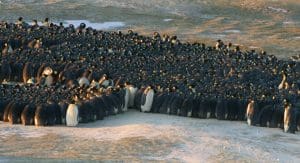
During winter, Emperor penguins form tight circles called huddles. In these groups, they stand close together to share body heat. Meanwhile, penguins on the outside slowly move toward the center to warm up. Then, others take their place on the edge.
As a result, everyone gets a turn in the warm spot.
This behavior shows strong teamwork. No penguin fights for the best position. Instead, they rotate naturally. Consequently, the group survives the freezing wind. If you are fascinated by marine life, you will also enjoy reading about The biology of giant squid.: Secrets of the Ocean’s Gentle Giant, where we explore the mysterious creature that shares the icy waters with Antarctic predators.
Communication and Recognition
Penguins are also great communicators. They use loud calls to find their mates and chicks. Surprisingly, each penguin has a unique voice.
For example, when a parent returns from the sea, it calls out. Then, its chick answers back. Even in a noisy colony, they recognize each other’s voices.
In addition, penguins use body movements. They bow, flap their wings, and stretch their necks. These gestures help them show respect or warn others.
Therefore, communication plays a key role in their survival.
Parenting: A Story of Patience and Love🐟
Penguin parenting is one of the most touching behaviors in Antarctica.
The Emperor Penguin’s Sacrifice
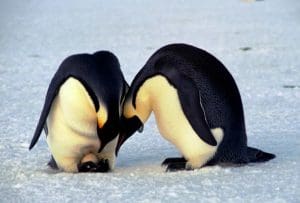
The Emperor penguin is famous for its unique breeding cycle. Unlike most birds, they breed during winter.
First, the female lays one egg. Then, she carefully passes it to the male. After that, she walks many kilometers to the ocean to find food.
Meanwhile, the male balances the egg on his feet under a warm fold of skin. He does not eat for about two months. Instead, he stands in the cold and protects the egg from freezing.
Eventually, the chick hatches. Soon after, the mother returns with food.
This cycle shows deep dedication. Both parents share responsibility. Consequently, their chick has a better chance to survive.
Feeding the Chicks
Once the chick grows, both parents take turns hunting. They travel long distances to catch fish, krill, and squid.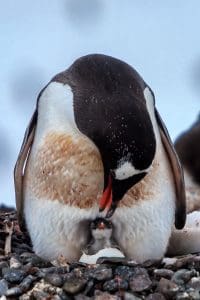
Later, they return and feed the chick by regurgitating food. Although this may sound strange, it is essential for survival.
In this way, penguin parents show strong commitment and care.
Hunting and Feeding Behavior🐟
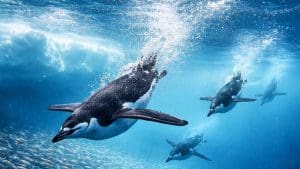
Penguins are expert swimmers. In fact, they spend most of their lives in the water.
Masters of the Ocean
Their wings act like flippers. Therefore, they move quickly underwater. Some species can swim up to 15 km/h (9 mph).
Moreover, they dive deep to catch prey. The Emperor penguin can dive deeper than 500 meters.
During a hunt, penguins work efficiently. They chase schools of fish and snap them up quickly. As a result, they gather enough energy to survive the cold. Moreover, if you want to understand why seafood plays such an important role in penguin nutrition and human health, don’t miss Omega-3 fatty acids in seafood: A simple and friendly guide for everyone, a clear and practical explanation for readers of all ages.
Protection from Predators
However, the ocean is not always safe. Penguins face predators like leopard seals and orcas.
Therefore, they use group strategies. Before jumping into the water, they often wait together at the edge of the ice. Finally, one penguin dives in. Then, the others follow quickly.
This reduces individual risk. Consequently, their survival rate increases.
Adaptations to Extreme Cold🐟
Penguins have special physical traits that support their behavior.
Thick Feathers and Fat
First, they have dense, waterproof feathers. Beneath those feathers lies a thick layer of fat called blubber.
Because of this insulation, their body heat stays inside. Even when they swim in icy water, they remain warm.
Smart Energy Use
Additionally, penguins conserve energy. They move slowly on land. Sometimes, they slide on their bellies, a movement called tobogganing.
This method saves energy and helps them travel faster across ice.
As a result, they waste less strength in harsh conditions.
Intelligence and Emotional Behavior🐟
Penguins may look funny, but they show signs of intelligence.
For example, they remember nesting spots. They recognize their partners year after year. Furthermore, many species form long-term pair bonds.
Although not perfect, these bonds help create stable families.
In some colonies, penguins even steal small stones from neighbors to build better nests. While this may seem sneaky, it shows problem-solving skills.
Therefore, penguins demonstrate both emotional connection and clever thinking.
Why The behavior of penguins in Antarctica. Matters🐟
Now that we understand their habits, we can see why penguin behavior is important.
First, their survival strategies teach us about adaptation. Second, their teamwork shows the power of unity. Third, their parenting reveals deep commitment.
Moreover, scientists study penguins to understand climate change. When sea ice melts, penguin hunting patterns change. Consequently, their population numbers can decrease.
Organizations like World Wildlife Fund monitor penguin populations. In addition, the National Geographic Society shares research about Antarctic wildlife.
Therefore, protecting penguins also protects the Antarctic ecosystem.
Lessons We Can Learn🐟
So, what can humans learn from penguins?
- Teamwork increases survival.
- Sharing responsibilities strengthens families.
- Adapting to change is essential.
- Communication builds strong communities.
In conclusion, penguins may live far away in icy lands. However, their behavior carries lessons for all of us.